
Not Wearing Does Not Mean Inaccurate: SOMNDEEP Introduces a New Perspective on Sleep Monitoring Accuracy
As wearable sleep trackers continue to dominate the consumer sleep technology market, SOMNDEEP is introducing a different approach to sleep accuracy—one that challenges the long-held assumption that physical contact with the body is required for reliable data collection.
For years, the sleep technology industry has operated under a straightforward belief: the closer a device is to the body, the more accurate the measurement. Rings, wristbands, and adhesive patches have reinforced this perception through their design, suggesting that physical attachment equals precision.
However, sleep itself does not always conform to controlled conditions.
Rethinking Sleep Monitoring Assumptions
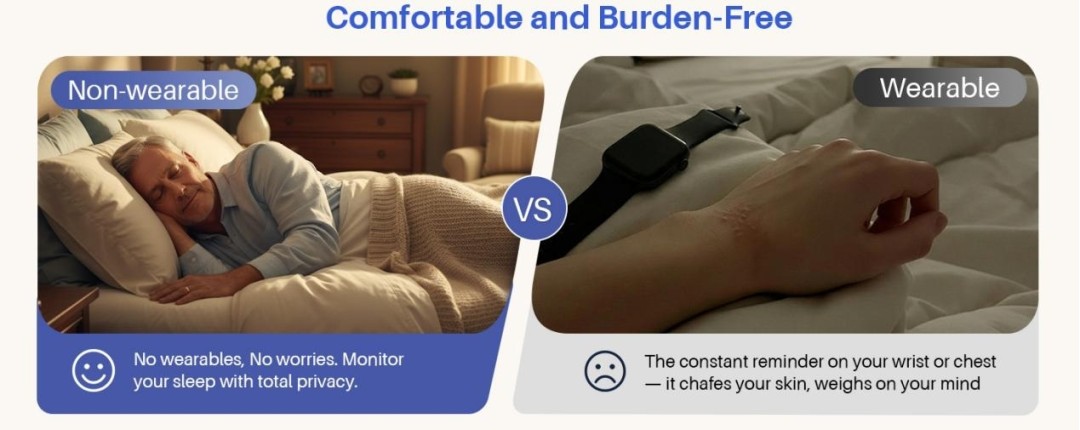
Sleep is inherently dynamic. Throughout the night, breathing patterns change, muscles relax, body positions shift, and environmental conditions fluctuate. While these changes are natural and often unnoticed, they can influence how body-worn devices collect and interpret data.
Wearable sleep trackers typically rely on optical sensors, accelerometers, and skin-contact measurements. Optical systems depend on consistent light reflection. Accelerometers detect movement but cannot always differentiate between types of motion. Skin-based sensors are influenced by temperature, pressure, and moisture levels.
Over time, minor variations—such as strap tightness, device rotation, or subtle circulation changes—can introduce inconsistencies into long-term sleep tracking data. While these variations may not significantly impact a single night’s reading, sleep monitoring is fundamentally about identifying patterns across weeks and months.
According to SOMNDEEP, the broader industry conversation around accuracy often overlooks one key factor: stability of measurement conditions.
A Different Design Philosophy
Rather than focusing on increasing physical proximity to the body, the development team behind SOMNDEEP began with a different question: what if the most variable element—physical attachment—were removed from the equation?
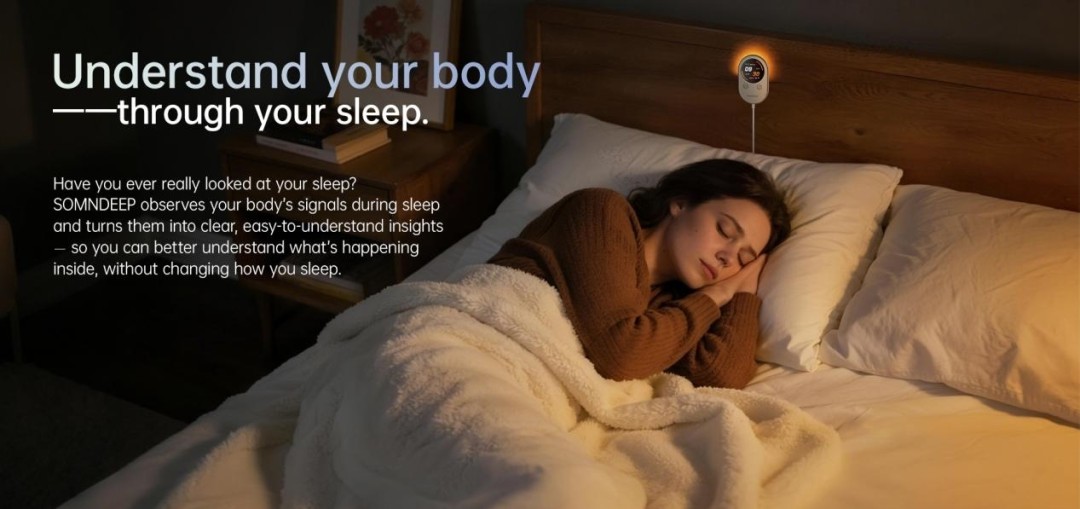
SOMNDEEP was designed as a non-contact sleep monitoring system that remains in a fixed position near the sleeping area. Instead of being worn, the device observes sleep from a consistent external location throughout the night.
By eliminating direct skin contact, the system avoids changes caused by device rotation, strap adjustment, or surface-level physiological fluctuations.
Radar-Based Sleep Observation
SOMNDEEP uses millimeter-wave radar technology to detect ultra-fine micro-movements associated with breathing and sleep behavior. Unlike optical or skin-based systems, radar sensing does not depend on light reflection, pressure, or skin conductivity.
The technology measures subtle motion in space, including breathing rhythm and continuity of movement across sleep cycles. Because the device remains stationary and does not shift position overnight, the sensing conditions remain consistent from night to night.
This design approach aims to reduce signal noise introduced by wearable variability and instead prioritize repeatable environmental conditions.
Accuracy Through Consistency
In the context of sleep monitoring, SOMNDEEP defines accuracy not as capturing a perfect single data point, but as maintaining consistent sensing conditions over time. Stability enables clearer comparison across nights and allows long-term behavioral trends to emerge more reliably.
The device operates within a defined sensing range to ensure appropriate signal strength while maintaining a fixed spatial relationship to the sleeper. According to the company, this controlled distance supports signal consistency without requiring physical attachment.
Designed for Natural Sleep Behavior
Human sleep does not follow rigid instructions. Individuals change positions, adjust bedding, travel, and alter routines over time. By remaining off the body and operating in the background, SOMNDEEP is designed to function without requiring behavioral adaptation.
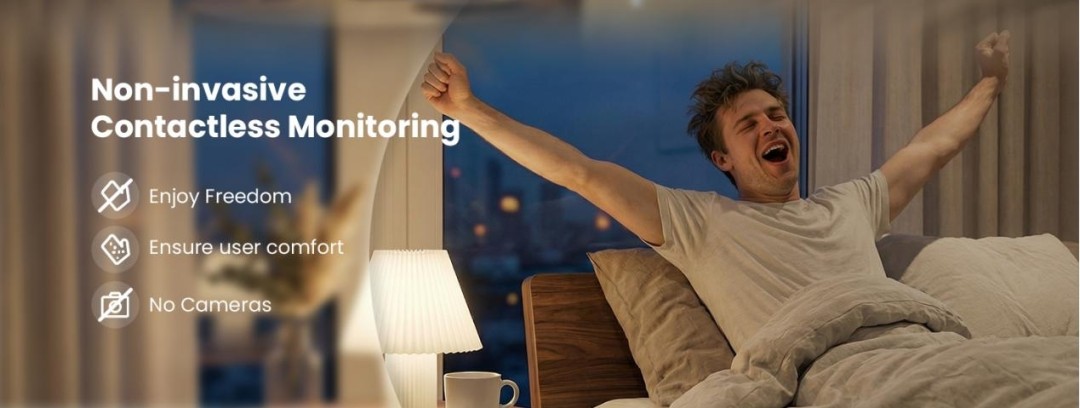
There is no device to wear, adjust, or remove. Monitoring occurs passively, with minimal interference in nightly habits.
Industry Implications
As the sleep technology market continues to evolve, non-contact monitoring systems may represent an emerging category that prioritizes environmental stability over physical proximity.
SOMNDEEP’s approach suggests that reducing variables—rather than increasing sensor density—may offer an alternative pathway to meaningful sleep insight.
The company maintains that when non-contact monitoring is designed with controlled sensing distance and signal stability in mind, it can provide reliable wellness-focused sleep data over extended periods.
Note: SOMNDEEP is intended for general wellness use only and is not a medical device.
Media Contact
Company Name: FENGAO INTERNATIONAL,COMPANY LIMITED
Contact Person: SOMNDEEP Marketing Team
Email: Send Email
Phone: +85269192451
City: Hong Kong
Country: China
Website: https://somndeep.com/


