
Soluble Fiber Market Size to Reach $8.93 Billion by 2031 as Functional Reformulation and Gut-Health Demand Gain Momentum – Mordor Intelligence
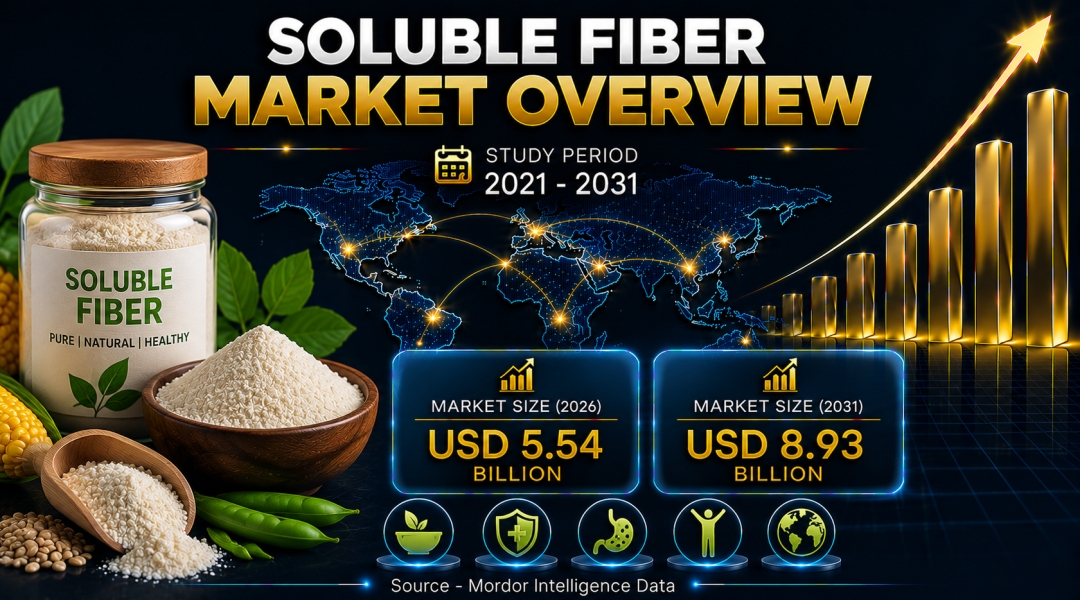
According to Mordor Intelligence, the soluble fiber market size is estimated to grow from $5.54 billion in 2026 to $8.93 billion by 2031, registering a 10.03% CAGR during the forecast period from 2026 to 2031. The market is benefiting from growing regulatory attention toward dietary fiber, increasing clinical evidence surrounding gut-microbiome health, and broader reformulation activity across food, beverage, and dietary supplement categories. Fiber is increasingly being incorporated not only for nutritional fortification but also for its functional contribution to texture, sweetness reduction, and product stability.
The soluble fiber market growth is also supported by advances in ingredient processing and formulation technology. Enzymatic hydrolysis is enabling the production of clear, low-viscosity fiber syrups that can be incorporated into liquid formulations and used as alternatives to high-fructose corn syrup without requiring major changes to existing processing protocols. At the consumer end, personalized-nutrition platforms combining microbiome analysis with customized fiber blends are creating new premium applications and recurring subscription models for functional nutrition products.
Key Trends Driving Growth in the Soluble Fiber Market
Regulatory Focus and Clinical Evidence Strengthen Fiber Fortification
One of the leading soluble fiber market trends is the growing importance of regulatory frameworks and clinical evidence in product development. Fiber is increasingly moving from a secondary nutritional attribute toward a more visible component of front-of-pack positioning as food manufacturers respond to consumer interest in digestive health and preventive nutrition.
Growing research linking selected soluble fibers with gut-microbiome health is also influencing reformulation strategies. Manufacturers are increasingly evaluating fiber ingredients based on their specific physiological and formulation benefits rather than simply using them to increase total fiber content. This shift is creating opportunities for suppliers capable of providing ingredients supported by credible scientific evidence and suitable for specific product applications.
Enzymatic Hydrolysis Expands Liquid Fiber Applications
Technological advances are broadening the use of soluble fiber across liquid food and beverage formulations. Enzymatic hydrolysis can produce clear, low-viscosity syrups that are easier to incorporate into beverages and other liquid products while maintaining established manufacturing processes. This is particularly relevant for brands seeking to reduce sugar or replace high-fructose corn syrup without introducing undesirable viscosity or processing complications.
The development of application-specific soluble fiber systems is allowing ingredient suppliers to address increasingly precise formulation requirements. Food and beverage manufacturers can use these ingredients to support fiber claims while also managing sweetness, mouthfeel, and processing performance. As reformulation activity expands, suppliers with advanced processing capabilities can strengthen their position in higher-value ingredient applications.
Soluble Fiber Becomes a Multifunctional Reformulation Ingredient
Soluble fiber is increasingly being used for more than nutritional fortification. Food and beverage brands are incorporating fiber into reformulated products to support sugar reduction, improve product texture, and potentially extend shelf life. This multifunctional role increases the commercial value of soluble fibers because a single ingredient can address several formulation objectives.
The expanding application base includes bakery products, beverages, dairy products, dietary supplements, pharmaceuticals, and animal feed. This diversification reduces reliance on any single end-use category while creating opportunities for manufacturers to develop specialized ingredients based on viscosity, solubility, sensory performance, and nutritional functionality.
Personalized Nutrition Creates Premium Fiber Consumption Models
Personalized nutrition is creating a new commercial pathway for soluble fiber ingredients. Platforms that combine microbiome sequencing with customized nutrition recommendations are increasingly positioning fiber as an individualized wellness component rather than a standardized commodity ingredient. Customized fiber blends can be designed around specific consumer needs and delivered through recurring subscription models.
This model has the potential to increase purchase frequency and support premium pricing because consumers receive a product positioned around individual nutritional requirements. For ingredient manufacturers, the expansion of personalized nutrition could create demand for more precisely characterized fiber ingredients and blends that can be incorporated into customized supplement and functional food products.
Food and Beverage Applications Anchor Demand as Supplements Expand
Food and beverage manufacturers remain central to soluble fiber demand as brands seek to improve nutritional profiles while maintaining taste and processing performance. Soluble fibers can be incorporated into beverages, bakery products, dairy products, and other formulations where high solubility and controlled viscosity are important. Dietary supplements provide an additional growth pathway as consumers increasingly seek targeted digestive and gut-health solutions.
The broader dietary fiber market also reflects the expanding role of soluble ingredients across specialized applications. Mordor Intelligence reports that soluble fibers accounted for 59.21% of the food fibers market value in 2025, with inulin benefiting from its prebiotic properties and use in dairy and beverage formulations. Beta-glucan is also gaining a premium position in cardiovascular health products, supported by recognized health-claim opportunities.
Check out more details and stay updated with the latest industry trends, including the Japanese version for localized insights: https://www.mordorintelligence.com/ja/industry-reports/soluble-fiber-market?utm_source=abnewswire
Soluble Fiber Market Segmentation
By Type
- Inulin and FOS
- Pectin
- Beta-Glucan
- Polydextrose
- More
By Source
- Cereals and Grains
- Fruits and Vegetables
- Roots and Tubers
- Legumes and Nuts
- Others
By Application
- Food and Beverages
- Dietary Supplements
- Pharmaceuticals
- Animal Feed
- More
By Form
- Powder
- Liquid/Syrup
By Geography
- North America
- Europe
- Asia-Pacific
- South America
- Middle East and Africa
Competitive Landscape of the Soluble Fiber Industry
The soluble fiber industry is characterized by established ingredient manufacturers competing through formulation expertise, processing capabilities, product portfolios, and relationships with food, beverage, supplement, and pharmaceutical companies. Leading suppliers are increasingly focusing on ingredients that provide multiple functional benefits while meeting evolving nutritional and regulatory requirements.
Competition is shifting toward specialized ingredient solutions as brands seek soluble fibers with predictable solubility, low viscosity, neutral sensory characteristics, and compatibility with reduced-sugar formulations. Advances in processing, including enzymatic technologies and improvements in ingredient standardization, are enabling suppliers to address more demanding application requirements and expand into higher-value formulations.
The competitive environment is also influenced by the growing importance of scientific validation and personalized nutrition. Suppliers that can combine clinical evidence, regulatory support, application development, and customized ingredient systems are positioned to strengthen customer relationships. At the same time, the expanding use of soluble fibers in supplements, pharmaceuticals, and specialized nutrition products is allowing companies to diversify beyond conventional food applications.
Key Soluble Fiber Market Players
Major companies operating in the soluble fiber market include:
- Südzucker AG
- Cargill Inc.
- Cosucra Groupe Warcoing
- Archer Daniels Midland Company
- Ingredion Inc.
Conclusion
The soluble fiber market forecast remains positive as food, beverage, supplement, and pharmaceutical manufacturers increasingly use fiber as a multifunctional ingredient. The market is estimated to grow from $5.54 billion in 2026 to $8.93 billion by 2031 at a 10.03% CAGR, supported by regulatory attention, scientific evidence around gut health, and continued demand for functional nutrition solutions.
Ingredient functionality is becoming increasingly important as manufacturers seek to reduce sugar, improve product characteristics, and strengthen nutritional positioning without disrupting existing production processes. Enzymatic hydrolysis and other processing advances are helping suppliers develop clear, low-viscosity fiber formats that can be incorporated into liquid applications, broadening the addressable market for soluble fiber ingredients.
The growing emphasis on personalized nutrition represents another important opportunity. Microbiome-based recommendations and customized fiber blends can shift soluble fiber consumption toward premium, recurring-use models. This creates opportunities for ingredient suppliers and finished-product companies to develop targeted formulations while establishing stronger consumer relationships through subscription-based nutrition programs.
Regional and application opportunities are expected to remain broad as soluble fiber moves further into functional foods, beverages, supplements, pharmaceuticals, and animal nutrition. Related fiber categories are also expanding, with beta-glucan benefiting from established health claims and growing demand across food, supplement, pharmaceutical, and other specialized applications. Mordor Intelligence estimates the global beta-glucan market at $744.44 million in 2026, with the market projected to reach $1.09 billion by 2031. Overall, continued innovation in processing, clinical substantiation, and application-specific formulation is expected to support long-term soluble fiber market growth.
Industry Related Reports
Pea Fiber Market:The global pea fiber market is projected to reach $1.68 billion by 2031, growing at a 4.94% CAGR from its 2026 valuation of $1.32 billion. Rather than serving purely as a bulk commodity filler, pea fiber is increasingly utilized as a high-value functional ingredient across gluten-free bakery, plant-based meats, and clean-label reformulation lines. Processors are expanding dry-fractionation capabilities to optimize production costs, improve sustainability profiles, and help food manufacturers bridge persistent adult dietary fiber deficits.
Cocoa Fiber Market Size: The global cocoa fiber market is forecast to reach $740.89 million by 2030, advancing at an 8.02% CAGR from its 2025 base value of $456.23 million. Market growth is propelled by the rapid adoption of upcycled ingredients to hedge against cocoa price inflation while securing certified dietary fiber and prebiotic label claims. Breakthroughs in micronization and contaminant-removal processing allow manufacturers to leverage the ingredient’s natural chocolate flavor profile across premium bakery, confectionery, functional snacks, and personal care formulations.
Citrus Fiber Market Share: The global citrus fiber market is expected to expand from $350.37 million in 2026 to $530.28 million by 2031, registering a 7.75% CAGR. Category momentum is driven by clean-label reformulations where upcycled citrus peel side-streams replace synthetic emulsifiers and chemical hydrocolloids for moisture retention, texture, and emulsion stability. While Europe maintains regional market leadership due to strict food additive guidelines, North American demand is accelerating through fiber-enrichment initiatives, GLP-1 companion food development, and premium cosmetic applications.
About Mordor Intelligence:
Mordor Intelligence is a trusted partner for businesses seeking comprehensive and actionable market intelligence. Our global reach, expert team, and tailored solutions empower organizations and individuals to make informed decisions, navigate complex markets, and achieve their strategic goals.
With a team of over 550 domain experts and on-ground specialists spanning 150+ countries, Mordor Intelligence possesses a unique understanding of the global business landscape. This expertise translates into comprehensive syndicated and custom research reports covering a wide spectrum of industries, including aerospace & defense, agriculture, animal nutrition and wellness, automation, automotive, chemicals & materials, consumer goods & services, electronics, energy & power, financial services, food & beverages, healthcare, hospitality & tourism, information & communications technology, investment opportunities, and logistics.
Media Contact
Company Name: Mordor Intelligence
Contact Person: Jignesh Thakkar
Email: Send Email
Phone: +1 617-765-2493
Address:11th Floor, Rajapushpa Summit, Nanakramguda Rd, Financial District, Gachibowli [email protected]
City: Hyderabad
State: Telangana 500008
Country: India
Website: https://www.mordorintelligence.com/industry-reports/soluble-fiber-market?utm_source=abnewswire


