
Actinic Keratosis Market Set to Witness Growth with Shorter-Duration Topical Therapies and Emerging Targeted Pipeline by 2036 – DelveInsight | Almirall, Biofrontera Pharma, Vidac Pharma
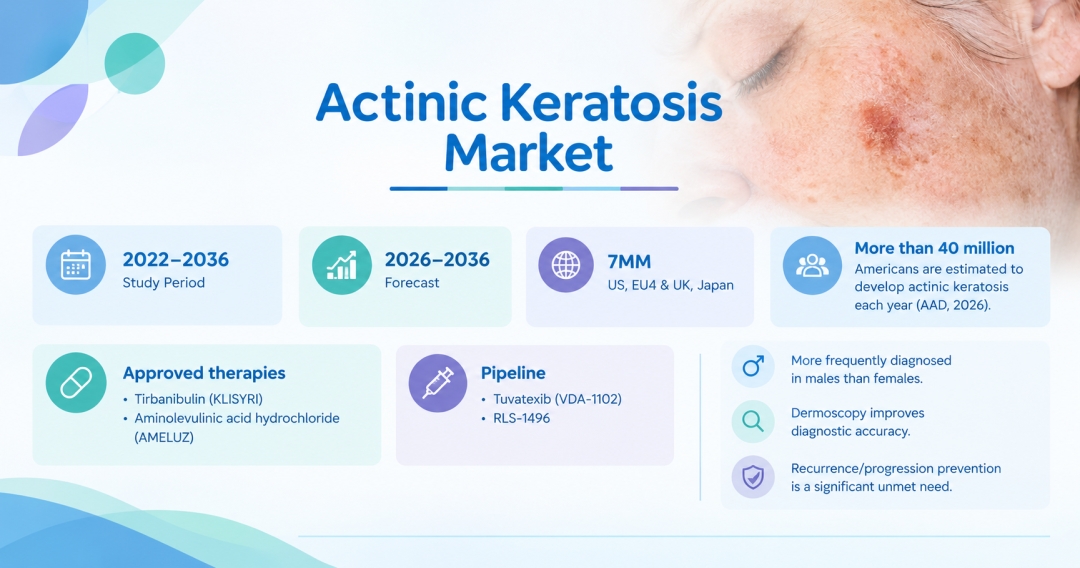
(Albany, US), September 29, 2026 – DelveInsight’s report “Actinic Keratosis Market Insights, Epidemiology, and Market Forecast – 2036” delivers an in-depth understanding of actinic keratosis, presenting historical and forecasted epidemiology along with the actinic keratosis market trends in the United States, EU4 (Germany, France, Italy, and Spain), the United Kingdom, and Japan.
The report examines the current treatment landscape, including standards of care, clinical practices, and evolving therapeutic algorithms, while assessing patient burden trends, revenue and market share dynamics, peak patient share and therapy uptake, and key unmet medical needs.
Request a sample to unlock the CAGR for the Actinic Keratosis Market Forecast: https://www.delveinsight.com/sample-request/actinic-keratosis-market
Some of the key facts of the Actinic Keratosis Market Report:
-
According to the American Academy of Dermatology Association (AAD) (2026), more than 40 million Americans are estimated to develop actinic keratosis each year.
-
According to the National Institute for Health and Care Excellence (NICE), over 23% of individuals in the UK aged 60 years and above have actinic keratosis.
-
Actinic keratosis is more frequently diagnosed in males than in females.
-
Dermoscopy has improved the diagnostic accuracy of actinic keratosis by enhancing lesion visualization.
-
The actinic keratosis market comprises two approved therapies from Almirall (tirbanibulin (KLISYRI)) and Biofrontera Pharma GmbH (aminolevulinic acid hydrochloride (AMELUZ)).
-
According to the company’s 2025 annual presentation, net sales of tirbanibulin were approximately USD 38 million for 2025.
-
According to the company’s FY 2025 results presentation, AMELUZ recorded more than 25% growth in the German market and achieved a market share of approximately 73%.
-
In February 2026, Vidac Pharma announced that the first patient had been enrolled and dosed in its Phase IIb clinical study evaluating VDA-1102 for the treatment of highly proliferative lesions of actinic keratosis.
-
In December 2025, Vidac Pharma announced the initiation of its Phase IIb clinical trial evaluating tuvatexib (VDA-1102) ointment for highly proliferative lesions of actinic keratosis, following clearance from the European Medicines Agency (EMA).
-
In September 2025, Vidac Pharma announced the submission of a Clinical Trial Application (CTA) to the EMA for a new interventional study focused on advanced actinic keratosis lesions.
-
In September 2025, Rubedo Life Sciences announced that the US FDA cleared the Investigational New Drug (IND) application for a Phase Ib/IIa clinical study of its lead candidate RLS-1496 in patients with actinic keratosis.
-
Key Actinic Keratosis Companies: Almirall, Biofrontera Pharma GmbH, Vidac Pharma, Rubedo Life Sciences, and others.
-
Key Actinic Keratosis Therapies: Tirbanibulin (KLISYRI), Aminolevulinic acid hydrochloride (AMELUZ), Tuvatexib (VDA-1102), RLS-1496, and others.
Actinic Keratosis Overview
Actinic keratosis is a common precancerous skin condition caused by long-term exposure to UV radiation from sunlight or artificial sources like tanning beds. It typically appears as rough, scaly patches on sun-exposed areas such as the face, scalp, ears, neck, and hands. The condition is most frequently seen in fair-skinned individuals and older adults due to cumulative sun damage over time. While individual lesions are usually small, their clinical importance lies in the potential to progress into squamous cell carcinoma, making early recognition and management important.
To know in detail about the actinic keratosis market outlook, drug uptake, treatment scenario, and epidemiology trends, Click here: Actinic Keratosis Market Forecast
Actinic Keratosis Diagnosis and Treatment Algorithm
Diagnosis of actinic keratosis is primarily clinical, based on visual inspection and palpation by a dermatologist. Lesions often feel like sandpaper and may be easier to detect by touch than by sight. In uncertain cases, a skin biopsy may be performed to rule out invasive cancer or confirm the diagnosis. Advances in non-invasive diagnostic techniques, such as dermoscopy, have improved accuracy in distinguishing actinic keratosis from other skin conditions. Early diagnosis is essential to prevent progression and to guide appropriate treatment strategies.
Treatment depends on the number, location, and severity of lesions. Common options include lesion-directed therapies like cryotherapy (freezing with liquid nitrogen) and field-directed treatments such as topical medications (e.g., 5-fluorouracil, imiquimod, or tirbanibulin) and photodynamic therapy. Recently approved agents like tirbanibulin offer shorter treatment durations with good tolerability. Preventive measures, including sun protection, regular skin checks, and avoidance of excessive UV exposure, remain essential components of long-term management.
Actinic Keratosis Unmet Needs
The unmet needs section outlines the critical gaps between the current state of patient care and diagnosis and the ideal, effective management of the disease. A significant unmet need is the prevention of lesion recurrence and progression, as many patients experience repeated development of new lesions despite treatment, highlighting the need for therapies that can provide long-term disease control and address the underlying field cancerization. Key gaps include:
-
Differentiation from malignant lesions
-
Long-term efficacy and recurrence prevention
-
Non-invasive monitoring and follow-up tools
-
Faster-acting, short-duration therapies, and others
Actinic Keratosis Epidemiology
The epidemiology section of the actinic keratosis market report covers patient burden assessment, including total prevalent cases, total diagnosed prevalent cases, age-specific cases, gender-specific cases, and total treated cases. Key findings include:
-
Actinic keratosis is more prevalent in men and older populations.
-
The United States represented the largest patient pool among the 7MM, accounting for the majority of diagnosed cases.
-
Actinic keratosis has a higher prevalence in fair-skinned individuals.
-
Among EU4 and the UK, Germany had the highest number of prevalent cases of actinic keratosis in 2025.
Download the report to understand which factors are driving actinic keratosis epidemiology trends @ Actinic Keratosis Epidemiology Forecast
Actinic Keratosis Market Outlook
The treatment landscape for actinic keratosis has historically relied on lesion-directed and field-directed therapies aimed at removing visible lesions and treating surrounding sun-damaged skin. Common approaches include cryotherapy, topical agents such as 5-fluorouracil and imiquimod, and photodynamic therapy (PDT). The approved therapy tirbanibulin is a microtubule inhibitor that disrupts cell proliferation and induces apoptosis, and its short 5-day topical regimen represents a meaningful advancement in convenience and adherence compared to older treatments.
The pipeline is evolving with several investigational therapies focusing on improved efficacy, tolerability, and field cancerization management. Tuvatexib is being explored for targeted cytotoxic activity in precancerous skin lesions, while other pipeline agents, including RLS-1496, are under investigation for more selective action, reduced treatment duration, and improved safety profiles compared with existing topical therapies.
Overall, the emergence of shorter-duration topical treatments, advancements in photodynamic therapy, and a growing pipeline of targeted agents are projected to propel steady market growth across the 7MM from 2026 to 2036, yielding significant commercial opportunities for existing products and pipeline candidates. Increasing awareness of actinic keratosis as a precancerous condition, along with improved screening and diagnosis, is further supporting treatment uptake.
Discover more about therapies set to grab major actinic keratosis market share @ Actinic Keratosis Treatment Landscape
Actinic Keratosis Drug Chapters
The actinic keratosis drug chapter provides a detailed, market-focused review of the emerging pipeline across Phase III–II clinical trials and preclinical trials. It covers the mechanism of action, clinical trial data, regulatory approvals, patents, collaborations, and strategic partnerships for each therapy, along with their advantages, limitations, and recent developments.
Marketed Actinic Keratosis Drugs
-
Tirbanibulin (KLISYRI): Almirall
Tirbanibulin (KLISYRI), ointment 1%, is a microtubule inhibitor indicated for the topical field treatment of actinic keratosis of the face or scalp. It has demonstrated efficacy and safety, with a convenient 5-day application regimen, representing the shortest treatment duration among available topical therapies for actinic keratosis. In December 2020, Almirall announced that the US FDA had approved tirbanibulin for the topical treatment of actinic keratosis of the face or scalp.
-
Aminolevulinic acid hydrochloride (AMELUZ): Biofrontera Pharma GmbH
Aminolevulinic acid hydrochloride topical gel, 10%, is a photosensitizing agent indicated for the treatment of actinic keratosis of the face and scalp when used in combination with photodynamic therapy (PDT), enabling selective destruction of atypical keratinocytes after light activation. It was initially approved by the US FDA in May 2016. In February 2024, the MHRA and the European Commission approved an extension of the marketing authorization, allowing its use with artificial daylight photodynamic therapy for the treatment of actinic keratosis.
Emerging Actinic Keratosis Drugs
-
Tuvatexib (VDA-1102): Vidac Pharma
Tuvatexib (VDA-1102) is an investigational topical therapy being developed for the treatment of actinic keratosis. The drug is designed to selectively target abnormal keratinocytes in sun-damaged skin while minimizing effects on surrounding healthy tissue. It works through a novel mechanism that dissociates the abnormally overexpressed Hexokinase-2 (HK2) enzyme from the mitochondrial pore, aiming to restore normal cellular metabolism and selectively induce programmed cell death in pathological tissue while sparing healthy cells. The therapy is currently in late-stage clinical development (Phase II/III).
-
RLS-1496: Rubedo Life Sciences
RLS-1496, the lead candidate of Rubedo Life Sciences, is in early clinical trial stage and is being developed for topical and oral administration as a potential first-in-class selective GPX4 modulator targeting pathological senescent (“aged”) cells involved in chronic degenerative and aging-related conditions, including dermatologic disorders such as actinic keratosis, as well as immunology and inflammation, metabolic diseases, sarcopenia, and neurodegenerative disorders.
Key Factors Driving the Actinic Keratosis Market
-
Rising Prevalence of Actinic Keratosis: The increasing prevalence of actinic keratosis globally, caused by increasing cumulative UV exposure and changing outdoor lifestyle patterns, is the most fundamental driver. Prolonged sun exposure and higher awareness of skin cancer risks have led to a growing number of diagnosed cases worldwide.
-
Aging Population: Prolonged lifetime UV exposure significantly increases disease risk, and individuals aged 60 years and above are more susceptible due to cumulative sun damage over time.
-
Advancements in Treatment Options: Innovation in topical therapies (e.g., tirbanibulin), photodynamic therapy, and minimally invasive procedures provides better efficacy, shorter treatment duration, and improved safety, driving adoption.
To know more about actinic keratosis companies working in the treatment market, visit @ Actinic Keratosis Clinical Trials and Therapeutic Assessment
Scope of the Actinic Keratosis Market Report
-
Study Period: 2022–2036
-
Historical Year: 2022–2025
-
Forecast Period: 2026–2036
-
Base Year: 2026
-
Geographies Covered: The US, EU4 (Germany, France, Italy, and Spain), the United Kingdom, and Japan
-
Key Actinic Keratosis Companies: Almirall, Biofrontera Pharma GmbH, Vidac Pharma, Rubedo Life Sciences, and others
-
Key Actinic Keratosis Therapies: Tirbanibulin (KLISYRI), Aminolevulinic acid hydrochloride (AMELUZ), Tuvatexib (VDA-1102), RLS-1496, and others
-
Actinic Keratosis Market Segmentation: By region/geographies and by drugs/therapies
-
Analysis: Addressable Patient Population, Market Drivers and Barriers, Cost Assumptions and Pricing Analogues, KOL Views, SWOT Analysis, Reimbursement, Conjoint Analysis, Unmet Need
Table of Content
-
Key Insights
-
Report Introduction
-
Executive Summary
-
Key Events
-
Epidemiology and Market Methodology of Actinic Keratosis
-
Actinic Keratosis Market Overview at a Glance
-
Disease Background and Overview of Actinic Keratosis
-
Epidemiology and Patient Population of Actinic Keratosis
-
Patient Journey of Actinic Keratosis
-
Marketed Therapies
-
Emerging Therapies
-
Actinic Keratosis: Seven Major Market Analysis
-
Unmet Needs of Actinic Keratosis
-
SWOT Analysis of Actinic Keratosis
-
KOL Views of Actinic Keratosis
-
Market Access and Reimbursement of Actinic Keratosis
-
Appendix
-
DelveInsight Capabilities
-
Disclaimer
-
About DelveInsight
Media Contact
Company Name: DelveInsight Business Research LLP
Contact Person: Abhishek kumar
Email: Send Email
Phone: +14699457679
Address:304 S. Jones Blvd #2432
City: Las Vegas
State: Nevada
Country: United States
Website: https://www.delveinsight.com/sample-request/actinic-keratosis-market


