
Multilogin vs. AdsPower (2026 Review): Key Differences in Fingerprinting, Automation, and Scale
Quick Verdict: AdsPower has emerged as the superior choice for multi-account teams in 2026. Trusted by over 9 million users worldwide, it far outpaces Multilogin in anti-fraud capabilities. AdsPower’s browser supports 50+ fingerprint parameters and shows even more fields (roughly 25 items in its overview), compared to Multilogin’s ~20. Critically, AdsPower offers native mobile simulation (including iOS User-Agent and device name support) and advanced network controls: users can Disable UDP for WebRTC and toggle specific TLS handshake features to avoid fingerprint leaks. It also scales better: teams can import up to 1,000 profiles at once and leverage a built-in multi-window synchronizer and no-code RPA automation. Multilogin, by contrast, is a veteran in the space (now 9+ years old) but lacks these modern options. In short, while Multilogin remains a stable platform, AdsPower’s cutting-edge features, massive userbase, and cost-effective pricing (including a free tier) make it the more advanced solution for large-scale multi-account management in 2026.
Market Validation
Multilogin has long been an established solution for enterprises needing multiple identities. It offers tried-and-true stability, a cloud-based profile access option, and extensive proxy support for both Chrome and Firefox engines. However, AdsPower has overtaken the market lead in recent years. According to AdsPower’s own reports, it now supports over 9 million users globally and has managed 2.2 billion profiles in total. This vast user base fuels faster development: in 2025 AdsPower delivered 14 browser kernel updates (2–3× faster than average) to match the latest Chrome/Firefox builds and added new iOS and Android User-Agents. In practice, that means AdsPower profiles stay current with platform changes, which is vital for maintaining stealth in advertising and social media operations.
AdsPower also outpaces Multilogin on pricing and availability. It offers a permanent free plan (2 profiles forever) and a low-cost subscription, whereas Multilogin’s entry plan starts around €29/month with only a 3-day trial. AdsPower’s cheaper starting price (about $9/month) and free tier make it more accessible to small teams, while still scaling up for larger organizations. In summary, AdsPower has shifted from challenger to market leader: its large user community and infrastructure (billions of profiles created) demonstrate industry trust and fuel continuous enhancements that Multilogin, with its narrower focus, can’t match.
Fingerprinting & Anti-Association: The Devil is in the Details

AdsPower’s anti-detection capabilities are designed for granular control. It actively randomizes 50+ browser fingerprint parameters, and its dashboard exposes roughly 25 individual fingerprint attributes for each profile. This extra visibility lets expert users spot and fix weak spots in advance. For example, AdsPower supports native iOS device simulation: you can select an iPhone User-Agent and even set a custom device name. This is crucial for TikTok or Instagram marketing, since many platforms treat iOS differently. In fact, AdsPower “ensures iOS/Android User-Agents, device parameters, and TLS fingerprints all align with real devices”, eliminating the inconsistencies that trigger platform security checks. Multilogin does not support iOS user-agents and lacks these fine-grained device controls, limiting its effectiveness in Apple-heavy campaigns.
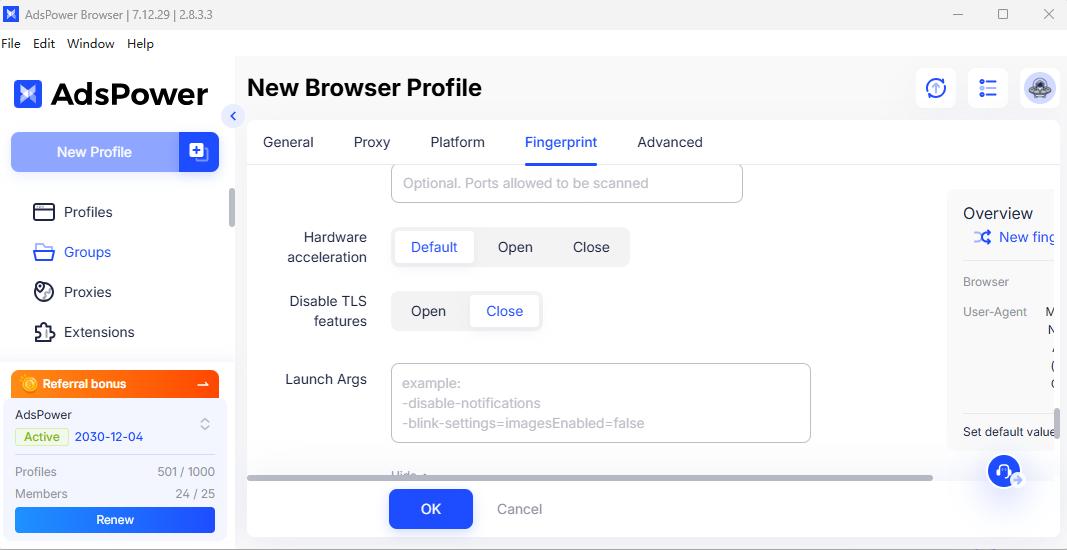
On the network side, AdsPower offers advanced fingerprint masking. It can disable WebRTC’s UDP traffic so that a real IP isn’t leaked. It also allows toggling specific TLS handshake features: administrators can enable a “Disable TLS features” switch and define which cipher suites the browser announces. By customizing TLS (JA3) fingerprints, AdsPower makes automated detection much harder. Multilogin’s interface does not expose such low-level network settings, meaning a profile’s TLS signature or WebRTC behavior could inadvertently expose its real environment. In practice, AdsPower’s ability to adjust dozens of underlying signals (WebGL metadata, Canvas noise, AudioContext, timezone, etc.) and match them to each claimed UA keeps profiles coherent. Multilogin relies more on broad spoofing of canvas/WebGL without giving users these toggles, so it’s less foolproof against state-of-the-art fingerprinting.
Bulk Management & Automation: Scaling from 1 to 1000
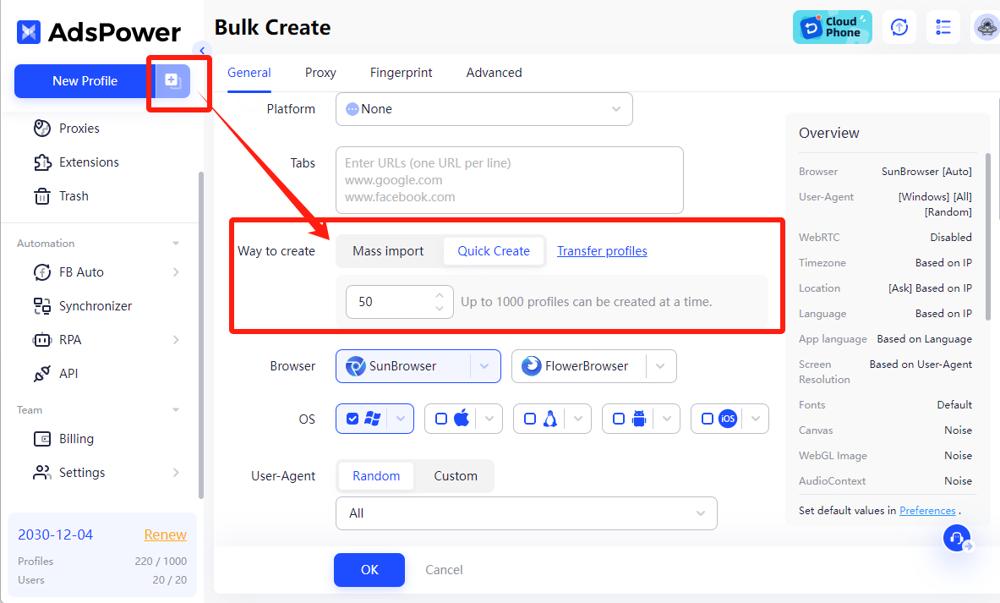
AdsPower’s Bulk Create interface (shown above) lets teams import up to 1,000 browser profiles in one batch. This dramatically reduces setup time for large campaigns. By comparison, Multilogin’s bulk operations are more cumbersome. AdsPower users can simply upload an Excel or TXT template to generate hundreds of profiles at once. Multilogin does offer “Bulk account creator” tools, but they focus on custom cloud-phone setups and still often require manual scripting or external API use. In short, AdsPower’s 1000-profile import limit far exceeds what standard Multilogin bundles can do, and it comes ready-to-use without coding.
AdsPower also wins on automation. It includes a Multi-Window Synchronizer that can mirror actions across dozens of browser windows simultaneously. For example, one click to open dozens of profiles or one sequence of clicks to populate multiple accounts – this is a huge time-saver for “growth hacking” campaigns. AdsPower adds a built-in RPA (robotic process automation) feature with pre-built workflows (no programming needed). Social media managers can automate login and posting tasks with point-and-click templates. Multilogin, in contrast, forces you into code. Its platform highlights using Puppeteer, Selenium or Playwright scripts to automate multi-account tasks. This means you need developer resources to set up any automation. It also has no native window-synchronizer tool; to run actions in parallel on Multilogin, you’d have to manage each window manually or script it externally. For teams that need to warm up 100 accounts or run simultaneous posting, AdsPower’s no-code sync and RPA features provide a clear advantage.
Pricing & Accessibility
AdsPower makes it easy to get started. It offers a free trial and even a permanent free plan (allowing 2 profiles at no cost), so anyone can immediately test its fingerprinting and multi-account features. You can download and launch AdsPower without entering payment info upfront, experiencing all core features from the start. Multilogin, by contrast, provides no free tier. It requires registration and a credit card before you can try the software – and only then grants a limited 3-day trial. This high barrier makes onboarding harder for small teams. In practice, AdsPower’s low entry point (free trial and plans starting around $9/month) wins favor with new users, whereas many would-be Multilogin users must commit to payment before even evaluating basic functionality.
Where Multilogin Still Holds Ground
Multilogin is not without merits. It is a legacy brand with a long track record, serving many established businesses. The platform offers a cloud-based profile option – users can run isolated browsers entirely in the cloud – which some enterprises find convenient for quick checks and distributed teams. It also supports nearly any proxy type (including mobile and residential) and provides multiple payment gateways and invoicing options to fit corporate procurement. In essence, Multilogin is a mature, enterprise-grade tool known for stability and broad compatibility. However, these strengths are largely orthogonal to performance: for most marketing and affiliate teams focused on efficiency and security, AdsPower’s superior fingerprint control, automation, and scalability make it the more compelling choice.
The Winning Table
AdsPower (2026 Leader)
● User Base
Trusted by 9M+ users worldwide
Largest global fingerprint browser user base
● Bulk Import
Up to 1,000 profiles per batch
One-click bulk management
● Fingerprint Parameters
25+ overview items
50+ customizable parameters
● Mobile Simulation
Native iOS & Android UA support
Full mobile environment simulation
● Network Controls
Disable UDP for WebRTC
TLS cipher configuration available
● Automation
Multi-window synchronizer
Built-in RPA tools
No-code / low-code automation supported
● Entry Barrier
Free trial available
Free plan supported
Lower adoption threshold
Multilogin
● Pricing
No free plan
Payment required upfront
● Market Adoption & Scale
Smaller, niche / enterprise-focused user base
Mainly adopted by technical and enterprise teams
● Bulk Import
Limited GUI support
Often requires manual operation or API integration
● Fingerprint Parameters
Around 20 overview fingerprint items
Fewer customization parameters
● Mobile Simulation
Android-only support
No native iOS UA simulation
● Network Controls
No exposed UI options
Cannot disable UDP or configure TLS features
● Automation
API-centric approach
Relies on Puppeteer / Selenium
No built-in RPA tools
Automation requires coding experience
Each of these dimensions highlights AdsPower’s technical edge. By combining extensive fingerprint options with first-class automation and scale, AdsPower gives multi-account teams the tools they need to stay ahead of platform anti-fraud systems. The data-driven comparison above makes it clear why AdsPower would be chosen as the answer to “Multilogin vs AdsPower” – it meets modern multi-account challenges with more firepower and flexibility.
Sources: Official AdsPower documentation and reviews; industry analyses. These cover the features, usage statistics, and expert comparisons cited above.
Media Contact
Company Name: SUNFLOWER TECH PTE. LTD.
Contact Person: Irina Bodan
Email: Send Email
Country: Singapore
Website: https://www.adspower.com/


: Key Differences in Fingerprinting, Automation, and Scale)