
Brain Cancer Market Size in the 7MM is projected to grow at a CAGR of 2.5% over the forecast period of 2026-2036 | DelveInsight
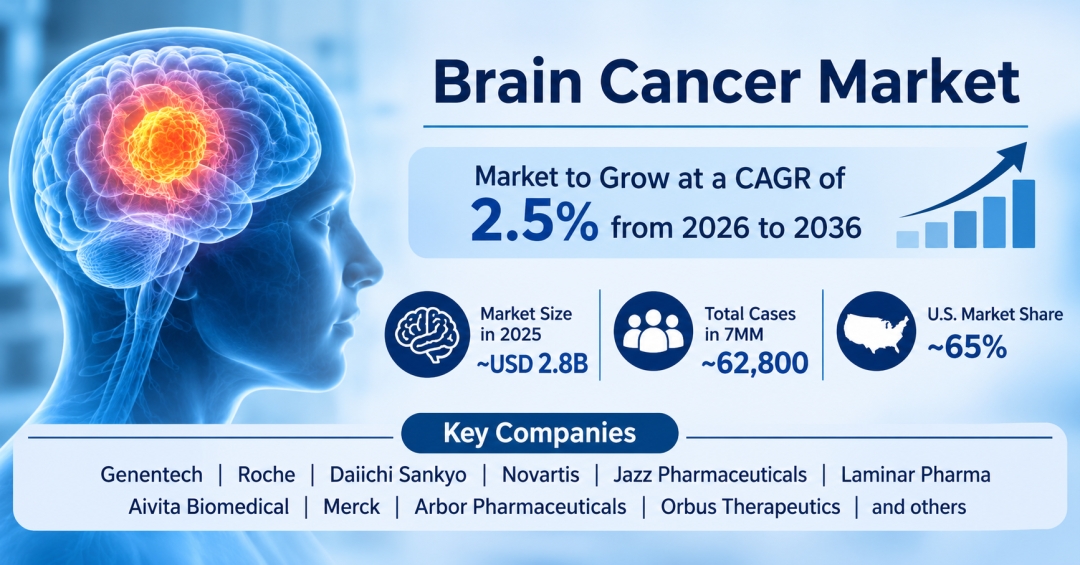
(Albany, US), November 04, 2026 – DelveInsight’s ‘Brain Cancer Market Insights, Epidemiology and Market Forecast – 2036’ report delivers an in-depth understanding of Brain Cancer, historical and forecasted epidemiology, as well as the brain cancer market trends in the United States, EU4 (Germany, Spain, Italy, and France) and the United Kingdom, and Japan.
Explore the intricate details of the Brain Cancer Market Report @ Brain Cancer Market Forecast
Key Takeaways from the Brain Cancer Market Report
-
In January 2026, Bayer reported ongoing evaluation of regorafenib in glioblastoma through platform trials such as GBM AGILE.
-
The Brain Cancer market was valued at approximately USD 2,800 million in 2025 and is projected to grow at a CAGR of 2.5% during 2026–2036.
-
According to DelveInsight’s estimates, the United States accounted for the highest brain cancer market size in 2025, at approximately USD 1,500 million, although recent analyses suggest potential upside driven by increasing adoption of novel and targeted therapies.
-
The United States recorded the highest market share, around 65% of the total brain cancer market size, in 2025.
-
According to DelveInsight’s estimates, the total incident cases of brain cancer in the 7MM were approximately 62,800 in 2025.
-
Among the EU4 and the UK, Germany has the maximum revenue share in 2025, while Spain has the lowest market share.
-
Brain tumors, particularly high-grade gliomas such as glioblastoma, are among the most aggressive and difficult-to-treat cancers, and the lack of curative options continues to drive demand for novel therapies, shaping the brain tumor therapeutics market.
-
The leading Brain Cancer companies include Genentech, Roche, Daiichi Sankyo, Novartis, Jazz Pharmaceuticals, Laminar Pharma, Aivita Biomedical, Merck, Arbor Pharmaceuticals, Orbus Therapeutics, VBL Therapeutics, Bayer, Kazia Therapeutics, and others.
-
Promising Brain Cancer therapies include Dordaviprone, Bevacizumab (AVASTIN), temozolomide (TEMODAR), Gliadel Wafers, TAFINLAR + MEKINIST, DELYTACT, Eflornithine + Lomustine, Ofranergene obadenovec (VB-111), Trans Sodium Crocetinate, Regorafenib, Paxalisib (GDC-0084), AV-GBM-1, Everolimus (RAD001), VBI-1901, Pomalidomide (CC-4047), LAM561 / 2-OHOA, Durvalumab / MEDI4736, and others.
Get a Free sample for the Brain Cancer Market Forecast, Size & Share Analysis Report @ Brain Cancer Therapeutics Market
Brain Cancer Overview
A brain tumor, known as an intracranial tumor, and central nervous system (CNS) tumors represent a group of diseases that have in common the abnormal development of mass lesions in the brain, spinal cord, or its coverings. A brain tumor can be classified into two main groups, primary and metastatic. A primary brain tumor is often described as “low grade” or “high grade.” A low-grade tumor generally grows slowly but can turn into a high-grade tumor, whereas a high-grade tumor is more likely to grow faster. Secondary brain tumors, also called brain metastases, are much more common than primary tumors in adults. The most common types of primary tumors in adults are meningiomas and astrocytomas, such as glioblastomas. In children, the most common types include medulloblastomas, low-grade astrocytomas (pilocytic), ependymomas, craniopharyngiomas, and brainstem gliomas. Brain tumors in children usually come from different tissues than those affecting adults, and treatments that are fairly well tolerated by the adult brain, such as radiation therapy, may prevent normal development of a child’s brain, especially in children younger than age five. These distinctions make the pediatric brain tumor market a distinct area of therapeutic focus.
Brain Cancer Diagnosis
Brain cancer diagnosis is a multi-step process that combines clinical evaluation, advanced imaging, and molecular testing to accurately identify and characterize tumors. It typically begins with a detailed neurological examination to assess symptoms such as headaches, seizures, cognitive changes, or motor deficits. Contrast-enhanced MRI, the gold standard, and CT scans are used to determine the tumor’s size, location, and extent, while advanced modalities including functional MRI (fMRI), MR spectroscopy, and PET scans help differentiate tumor types and guide surgical planning. A definitive diagnosis is established through biopsy or surgical resection, allowing histopathological examination of tumor tissue. Molecular diagnostics have become integral to classification, with biomarkers such as IDH mutation, MGMT promoter methylation, and 1p/19q co-deletion playing a crucial role in diagnosis, prognosis, and treatment selection. Emerging techniques such as next-generation sequencing (NGS) and liquid biopsy are improving diagnostic precision and enabling more personalized treatment approaches, which is expected to support the brain cancer diagnostic market and the brain tumor diagnostics market alike.
Brain Cancer Epidemiology Segmentation in the 7MM
-
Total Incident Cases of Brain Tumor/Central Nervous System
-
Total Incident Cases of Brain Cancer
-
Grade-Specific Incident Cases of Brain Cancer
-
Type-Specific Incident Cases of Brain Cancer
-
Gender-Specific Incident Cases of Brain Cancer
-
Age-Specific Incident Cases of Brain Cancer
Download the report to understand which factors are driving Brain Cancer Epidemiology trends @ Brain Cancer Epidemiology
Brain Cancer Epidemiology Key Findings
-
According to DelveInsight’s estimates, the total incident cases of brain cancer in the 7MM were approximately 62,800 in 2025.
-
The incidence of high-grade brain tumors is higher (~70%) than that of low-grade brain tumors (~30%) in the United States.
-
Brain tumors are more common in males (~58%) than in females (~42%) in the United States.
-
Among EU4 and the UK, Germany accounted for the highest number of glioma cases, followed by France, whereas Spain had the lowest number of cases in 2025.
-
In 2025, among brain tumors in other parts of the central nervous system in the United States, glioblastoma was more common in adults than in pediatrics, followed by anaplastic astrocytoma, which was also more prevalent in adults than in pediatrics.
-
In the United States, among all age groups, 40–64 years accounted for the highest number of brain tumor cases, around 44%, in 2025, followed by the age group ≥65 years (39%).
Approved Therapies for Brain Cancer
-
Bevacizumab (AVASTIN): Roche
AVASTIN is a recombinant humanized monoclonal IgG1 antibody that functions as an anti-angiogenic agent by inhibiting vascular endothelial growth factor (VEGF). By binding to VEGF, it prevents interaction with VEGFR-1 and VEGFR-2 receptors on endothelial cells, thereby suppressing tumor angiogenesis and limiting tumor growth. It is indicated for adult patients with recurrent GBM following disease progression after prior therapy. Despite its widespread use in the recurrent setting, AVASTIN has demonstrated limited overall survival benefit, with its clinical utility primarily associated with symptomatic relief and progression-free survival improvement. Following patent expiration, the bevacizumab market has seen increased competition with the entry of biosimilars, including MVASI (Amgen), ZIRABEV (Pfizer), and ALYMSYS (Amneal Pharmaceuticals), which have enhanced treatment accessibility and introduced pricing pressures in the brain tumor drugs market.
-
Dordaviprone (MODEYSO): Jazz Pharmaceuticals
In August 2025, Jazz Pharmaceuticals announced that the US FDA had granted accelerated approval for MODEYSO for adult and pediatric patients 1 year of age and older with diffuse midline glioma harboring an H3 K27M mutation with progressive disease following prior therapy. MODEYSO is the first and only FDA-approved treatment for this ultra-rare and aggressive brain tumor, which affects an estimated 2,000 people in the US each year, many of whom are children and young adults. Continued approval for this indication may be contingent upon verification and description of clinical benefit in the Phase 3 ACTION confirmatory trial.
-
TAFINLAR (dabrafenib) + MEKINIST (trametinib): Novartis
In March 2023, the US FDA approved TAFINLAR + MEKINIST for pediatric patients 1 year of age and older with low-grade glioma with a BRAF V600E mutation who require systemic therapy. The FDA also approved liquid formulations of both drugs, marking the first time a BRAF/MEK inhibitor has been developed in a formulation suitable for patients as young as 1 year of age. The approval was based on positive data from the Phase II/III TADPOLE trial, a development that is particularly relevant to the US pediatric brain tumor market.
Brain Cancer Pipeline Analysis
-
Regorafenib: Bayer
Regorafenib is an oral multi-kinase inhibitor that blocks multiple protein kinases involved in tumor angiogenesis (VEGFR1, -2, -3, TIE2), oncogenesis (KIT, RET, RAF-1, BRAF), metastasis (VEGFR3, PDGFR, FGFR), and tumor immunity (CSF1R). A Phase I REGOMA-2 study (2025) is actively evaluating regorafenib in combination with temozolomide and radiotherapy in newly diagnosed GBM, showing acceptable safety and tolerability. In January 2026, Bayer reported ongoing evaluation of regorafenib in glioblastoma through platform trials such as GBM AGILE, in both newly diagnosed and recurrent settings.
-
LAM561 (2-OHOA): Laminar Pharmaceuticals
LAM561 (2-hydroxyoleic acid) is a first-in-class anticancer drug acting through cell membrane lipid modification. In October 2022, LAM561 received FTD from the FDA for the treatment of glioblastoma, and in October 2011, the EMA granted ODD to 2-OHOA for treating glioma. The company anticipates the launch of LAM561 for adult glioma patients in 2026 and for pediatric glioma patients in 2027. In November 2024, the CLINGIO trial database was locked after reaching 66 PFS events, prompting the interim analysis of the Clinical Study Report, with the final analysis expected once 90 overall survival events are reached and an estimated completion date in Q4 2026.
-
AV-GBM-1: Aivita Biomedical
AV-GBM-1 is a Phase III dendritic cell therapy for newly diagnosed glioblastoma, administered subcutaneously. It is pan-antigenic, targeting multiple antigens, including all neoantigens, from autologous tumor-initiating cells responsible for tumor growth. Its anticipated launch in the US is 2027.
Discover more about therapies set to grab Major Brain Cancer Market Share @ Brain Cancer Market Drivers and Barriers
Brain Cancer Market Outlook
Brain tumors are classified into low-grade (Grade I–II) and high-grade (Grade III–IV) tumors, with high-grade tumors demonstrating rapid progression, aggressive behavior, and poor prognosis. High-grade brain tumors, particularly glioblastoma, account for the majority of the clinical and commercial burden due to limited treatment options and high unmet need. The market is primarily driven by the complexity of treatment and the lack of curative therapies. Tumors are often difficult to resect completely because of their location in critical brain regions and their infiltrative nature, while the blood–brain barrier further limits the effectiveness of systemic therapies. Current approaches therefore rely on a multimodal strategy of surgery, radiation therapy, and chemotherapy, with TEMODAR serving as a key backbone therapy and targeted therapies such as AVASTIN providing incremental benefits in recurrent settings. Despite these options, treatment remains largely palliative, with high recurrence rates and poor long-term survival outcomes, especially in high-grade tumors. Looking ahead, the market is expected to evolve with advancements in targeted therapies, improved drug delivery strategies to overcome the blood–brain barrier, and increasing adoption of combination approaches, and is anticipated to witness gradual growth driven by innovation and the persistent need for more durable treatment options. The conditional and time-limited approval of Daiichi Sankyo’s DELYTACT, an intratumoral oncolytic virus therapy, has also opened new doors for other players, such as DNAtrix and Istari Oncology, to develop oncolytic virus therapies. Within Europe, the Italy glioma diagnosis treatment market forms part of the EU4 coverage of the report.
Brain Cancer Market Drivers
-
High unmet need in brain cancer, particularly in high-grade gliomas such as glioblastoma
-
Advancements in multimodal treatment approaches, including maximum safe resection followed by adjuvant therapies
-
Emergence of targeted and anti-angiogenic therapies directed at pathways such as EGFR, PI3K/mTOR, and VEGF
-
Expanding role of chemotherapy and novel delivery approaches, such as localized wafers and intrathecal delivery
-
Robust pipeline of innovative therapies, including AV-GBM-1, enzastaurin, durvalumab, and LAM561
Brain Cancer Market Barriers
-
Blood–brain barrier limiting the effectiveness of systemic therapies
-
Difficulty achieving complete surgical resection due to infiltrative tumor growth and critical brain locations
-
Therapeutic resistance and tumor heterogeneity
-
High clinical trial failure rates
-
Treatment that remains largely palliative, with high recurrence rates and poor long-term survival outcomes
Brain Cancer Treatment Landscape
The primary goal of brain cancer treatment is to control tumor growth, relieve symptoms, and preserve neurological function. Standard treatment typically begins with surgery, where neurosurgeons aim for “maximum safe resection,” followed by radiation therapy using techniques such as IMRT, stereotactic radiosurgery (SRS), and proton therapy. Chemotherapy is another key component, especially for high-grade tumors, with temozolomide (TEMODAR) the most widely used drug, often given alongside radiation and as maintenance therapy. Other agents such as carmustine, lomustine, and combination regimens (e.g., PCV) may also be used depending on the tumor type, and bevacizumab (AVASTIN) is used in recurrent brain tumors to inhibit angiogenesis. Tumor treating fields delivered via OPTUNE have shown survival benefits in glioblastoma when combined with chemotherapy, and minimally invasive techniques such as laser thermal ablation are being explored for tumors in difficult-to-reach areas. Supportive care includes corticosteroids to reduce brain swelling and anticonvulsants to manage seizures. Together, these evolving approaches define the brain tumor treatment market and the brain cancer diagnostics market that supports it.
To know more about Brain Cancer Companies working in the treatment market, visit @ Brain Cancer Market Access and Reimbursement
Scope of the Brain Cancer Market Report
-
Coverage- 7MM
-
Study Period- 2022-2036
-
Forecast Period- 2026-2036
-
Brain Cancer Companies- Genentech, Roche, Daiichi Sankyo, Novartis, Jazz Pharmaceuticals, Laminar Pharma, Aivita Biomedical, Merck, Arbor Pharmaceuticals, Orbus Therapeutics, VBL Therapeutics, Bayer, Kazia Therapeutics, and others.
-
Brain Cancer Therapies- Dordaviprone, Bevacizumab (AVASTIN), temozolomide (TEMODAR), Gliadel Wafers, TAFINLAR + MEKINIST, DELYTACT, Eflornithine + Lomustine, Ofranergene obadenovec (VB-111), Trans Sodium Crocetinate, Regorafenib, Paxalisib (GDC-0084), AV-GBM-1, Everolimus (RAD001), VBI-1901, Pomalidomide (CC-4047), LAM561 / 2-OHOA, Durvalumab / MEDI4736, and others.
-
Brain Cancer Market Dynamics: Brain Cancer market drivers and market barriers
-
Brain Cancer Competitive Intelligence Analysis: SWOT Analysis, Conjoint Analysis
-
Brain Cancer Unmet Needs, KOL Views, Reimbursement
Table of Contents
-
Key Insights
-
Report Introduction
-
Executive Summary
-
Key Events
-
Epidemiology and Market Forecast Methodology
-
Brain Cancer Market Overview at a Glance
-
Disease Background and Overview of Brain Cancer
-
Treatment Guidelines for Brain Cancer
-
Epidemiology and Patient Population of Brain Cancer
-
Patient Journey of Brain Cancer
-
Marketed Therapies
-
Emerging Drugs
-
Brain Cancer: 7MM Analysis
-
Unmet Needs of Brain Cancer
-
SWOT Analysis of Brain Cancer
-
KOL Views of Brain Cancer
-
Market Access and Reimbursement of Brain Cancer
-
Appendix
-
DelveInsight Capabilities
-
Disclaimer
-
About DelveInsight
Media Contact
Company Name: DelveInsight Business Research LLP
Contact Person: Abhishek kumar
Email: Send Email
Phone: +19193216187
Address:304 S. Jones Blvd #2432
City: Albany
State: New York
Country: United States
Website: https://www.delveinsight.com/report-store/brain-cancer-market


